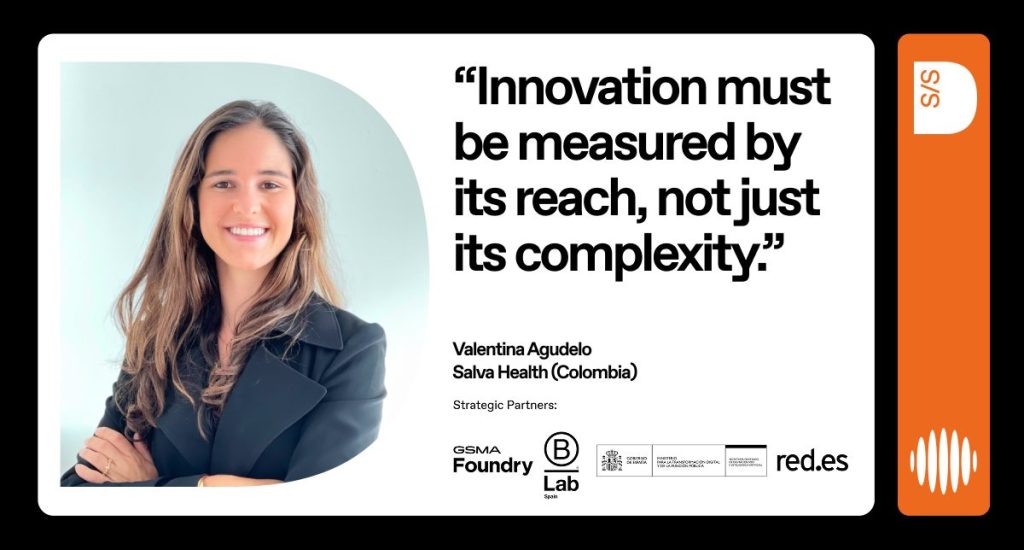
Valentina Agudelo, CEO of Salva Health
When we think of Deep Tech or medical innovation, we often imagine sterile laboratories, giant MRI machines, and million-dollar infrastructures. But for millions of women in rural Latin America, that version of innovation is not just expensive—it is invisible. It simply doesn’t reach them.
In Colombia, as in many developing nations, the fight against breast cancer has a geographical enemy: distance. The gold standard for detection, mammography, is centralized in big cities. For a woman in a remote village—like those in San Marcos, where we operate—getting a scan implies an expensive journey, days off work, and a painful procedure she fears. The result? She doesn’t go. And when the system finally “sees” her, it is often too late.
At Salva Health, we realized that the most sophisticated algorithm is useless if it cannot travel in a backpack to the middle of the rainforest. This realization shaped Julieta, our AI powered device for breast risk stratification. Winning the MWCapital Award is not just a recognition of our technology; it is a validation of a new philosophy: Innovation must be measured by its reach, not just its complexity.
Bridging the Gap: Excellence vs. Affordability
One of the hardest questions for a startup is balancing high-tech rigor with low-cost accessibility. How do you make cheap not mean inferior?
Our strategy was to change the question. We stopped trying to replicate a mammogram (which takes morphological images) and focused on physiology (how tissue behaves). By using Electrical Bioimpedance combined with Artificial Intelligence, we could build a device that doesn’t require radiation shields or massive power grids.
We shifted the value proposition from Diagnosis to Triage. Julieta acts as the Home Alarm that detects if something is wrong, while the mammogram remains the Security Camera that shows the detail. By positioning ourselves as the gatekeeper that filters and prioritizes risk, we reduce the burden on the healthcare system and make the technology affordable enough to be deployed in primary care centers. Excellence, for us, means efficiency in the route of care.
Scientific Accuracy in Low-Infrastructure Environments
Taking AI to the field is messy. There is no consistent internet, no climate control, and no specialized radiologists on site.
To balance accuracy with accessibility, we designed Julieta to be infrastructure-agnostic. It runs on batteries, works offline, and processes data using lightweight AI models that don’t require a supercomputer on-site. But the real challenge was trust.
We conducted rigorous clinical validations to ensure that our sensitivity (75%) and specificity (79%) were robust enough to be a reliable filter. We learned that in low-resource settings, the technology must be transparent. It cannot be a black box. Our interface doesn’t just spit out a code; it educates the local nurse and the patient, turning the exam into a moment of health literacy. When technology respects the user’s context, accuracy and adoption go hand in hand.
Systemic Changes for National Integration
For innovations like Julieta to scale from a pilot to a national standard; healthcare systems must shift from a Reactive Model to a Preventive Triage Model.
Currently, governments pay millions for late-stage cancer treatments but hesitate to reimburse early screening tools because they don’t fit traditional codes. We need a systemic update in public policy that values—and pays for—risk stratification. If we can prove to payers that catching a high-risk patient today costs a fraction of treating her next year, the integration becomes inevitable. We need regulatory sandboxes that allow AI tools to demonstrate value in real-world scenarios faster.
A Lesson for Future Innovators
If I could share one lesson with the innovators of tomorrow, it would be this: Don’t just build for the user; build for their reality.
It is easy to design for the patient who walks into a top-tier hospital. It is much harder, but infinitely more rewarding, to design for the woman who has never seen a doctor. True disruption happens when you take the most advanced science and make it feel simple, human, and accessible to the person who needs it most. Empathy is not a soft skill; it is the ultimate design specification.
Stay up to date about everything
Subscribe to stay up to date with the latest content from Mobile World Capital Barcelona.