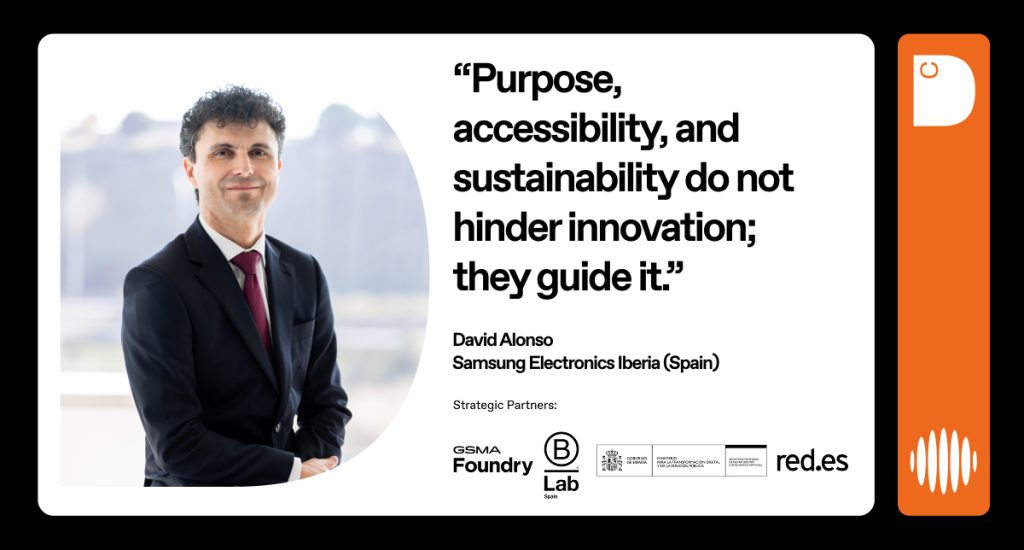
David Alonso, VP & Head of Mobile Experience, Samsung Electronics Iberia
Every time I participate in initiatives that celebrate innovation with social impact, such as the MWCapital Awards, I confirm that technology only has value if it contributes to collective well-being.
At Samsung, this vision is embodied in our “Technology with a Purpose” program, an initiative that for over 13 years has been driving projects that use innovation to improve people’s lives. More than 35 projects and half a million beneficiaries in Spain demonstrate that when technology is placed at the service of people, progress becomes more human and enduring.
The MWCapital Awards embody that same spirit: they recognize projects from six countries that apply artificial intelligence, blockchain, data analytics, and smart sensors to address global challenges. These success stories confirm that purpose and profitability are not opposites, but rather forces that mutually reinforce each other.
Inclusion and accessibility as drivers of innovation
For a global company, inclusion is not a goal, but a starting point. True innovation arises when we design with all people in mind, anticipating barriers and creating solutions that facilitate everyday life.
At Samsung, we integrate accessibility criteria from the design phase, not as a later addition. Collaborations such as the A TECH certification, developed together with ONCE Foundation, guarantee that our televisions —and soon our home appliances— are fully accessible.
Similarly, projects such as Tallk, which enables communication for people with ALS; Unfear and Unnoise, which reduce the impact of noise on people with auditory hypersensitivity; or Impulse, an application based on Artificial Intelligence to improve the daily lives of people with speech disorders, such as stuttering, are tangible examples of how technology can have a purpose beyond its technical function.
AI with empathy: Lessons learned from real-world implementation
Artificial intelligence has extraordinary potential to amplify human capacity, but it also demands responsibility. A responsibility that this year we have demonstrated through our project “The Mind Guardian,” a free, gamified, AI-based application for tablets designed to facilitate the screening of signs of cognitive decline in people over 55 years of age with 97% accuracy. Part of the “Technology with a Purpose” program, the application is presented as a video game for screening purposes that combines conventional neuropsychological tests with a playful and accessible user experience.
It integrates three cognitive assessments focused on episodic, semantic, and procedural memory and has the institutional endorsement of the Spanish Society of Primary Care Physicians (Semergen), the Spanish Society of Neurology (SEN), and the Spanish Society of Psychiatry and Mental Health (SEPSM).
Thanks to our experience, at Samsung we have learned that the positive impact of Artificial Intelligence depends on three key factors:
- Representative and diverse data, which avoid biases and reflect the plurality of users.
- Validation in real-world settings, to ensure its effectiveness with different profiles and needs.
- Ethical and transparent governance, which preserves human control and protects user trust.
When applied correctly, AI can become an ally for inclusion. From digital accessibility tools to predictive systems that optimize resources and reduce inequalities, technology can be a multiplier force for the common good.
Setting new global standards for responsible innovation
Leading companies have the opportunity —and the obligation— to define what the next generation of responsible innovation will look like.
At Samsung, we work to demonstrate that sustainability and competitiveness can coexist. At the same time, we foster collaboration with institutions, universities, and the third sector to create solutions that scale their impact.
Sharing methodologies, opening knowledge, and promoting ethical standards does not weaken competitive advantage: it strengthens it. Only through a collaborative ecosystem will we ensure that technology advances at the pace society demands while preserving its humanity.
Therefore, I want to share this reflection with all those preparing to innovate: do not design technology to demonstrate what you can do, but to solve what the world really needs. The most transformative ideas are not born from the power of technique, but from the commitment to people.
Purpose, accessibility, and sustainability do not slow down innovation: they guide it. They are the beacon that allows us to move toward a future where technology not only connects devices, but also opportunities, capabilities, and lives.
The MWCapital Awards remind us precisely of this: that true innovation is not about changing the world, but about making it better for everyone.
Stay up to date about everything
Subscribe to stay up to date with the latest content from Mobile World Capital Barcelona.