
- During 2025, 12 new technology centres from multinational companies were established, originating from eight countries and specialising in sectors such as healthcare, IT product development and services.
- International technology hubs located in Catalonia generate an economic impact of €4.109 billion and employ 46,080 professionals, 10% more than in 2024.
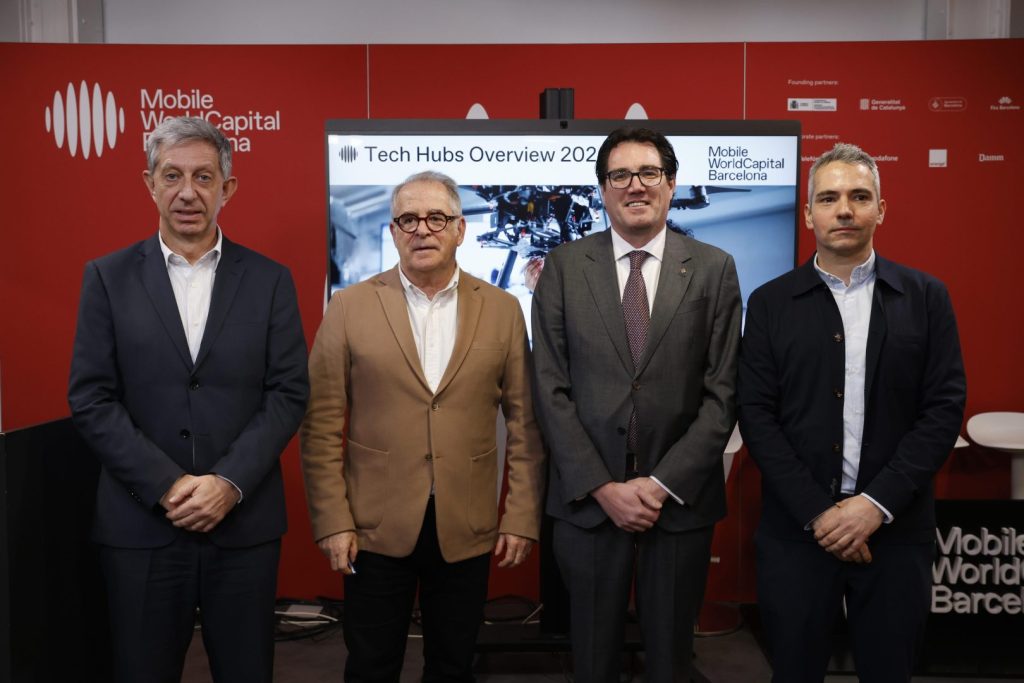
From left to right: the Chief Executive Officer of MWCapital, Francesc Fajula; the Deputy Mayor for Economy, Housing, Finance and Tourism at Barcelona City Council, Jordi Valls; the Secretary for Business and Competitiveness and CEO of ACCIÓ, Jaume Baró; and the Director of the Digital Talent area at MWCapital, Jordi Arrufí.
17/February/2026
Catalonia is currently home to 203 international technology hubs, which generate an economic impact of €4.109 billion and employ 46,080 professionals, 10% more than in 2024. These are the findings of the fourth edition of the Tech Hubs Overview report, presented this morning at a press conference. The report is promoted by Mobile World Capital Barcelona (MWCapital) in collaboration with ACCIÓ, the agency for business competitiveness of the Government of Catalonia, and the Directorate for International Economic Promotion of Barcelona City Council, part of the Economic Promotion, Tourism, International Relations and Sport Department. Its mission is to strengthen Barcelona’s economic relations with the rest of the world and its international positioning, as well as to reinforce links between companies and international talent, with the aim of boosting the local economy and attracting economic activity that generates prosperity and quality employment.
The study’s data reaffirm Catalonia’s position as an international innovation hub. In 2025 alone, the region incorporated 12 new technology hubs from multinational companies originating from Germany, China, France, the United States, Malta, Japan, Switzerland and the United Kingdom. These new centres have created 609 qualified jobs and generated an economic impact of more than €54 million.
These 12 new hubs are focused on the healthcare sector, IT product development and services. In terms of geographical distribution, seven are located in the city of Barcelona, four in the metropolitan area and one outside the metropolitan region.
Of the 203 hubs established in Catalonia, Barcelona remains the main location, hosting 70% of these technology centres. A further 20% are located in other municipalities of the metropolitan region, while the remaining 10% are spread across other parts of Catalonia.
During the presentation of the report, the General Director of Mobile World Capital, Francesc Fajula, stated that “the arrival of new international technology hubs strengthens our country’s competitiveness and confirms Catalonia’s attractiveness as a hub for innovation and digital talent”.
In his remarks, Jaume Baró Torres, Secretary for Business and Competitiveness and CEO of ACCIÓ, highlighted that “these results show that Catalonia has much to contribute to the new order of the global economy”. He added: “The fact that 80% of the multinational companies that have opened technology centres in Catalonia have done so with the support of ACCIÓ demonstrates the importance for the Government of attracting this type of centre, generating more and better knowledge in our country and connecting it with the local business fabric.”
Meanwhile, Jordi Valls, Barcelona’s Deputy Mayor for Economy, Housing, Finance and Tourism, pointed out that “the report certifies, once again, the growing international competitiveness of the city of Barcelona and its surrounding area as a magnet for technology development centres. This concentration is not the result of chance: it is the outcome of a robust ecosystem capable of attracting and generating talent, investment and high value-added projects, supported by first-class technological infrastructures and an excellent university and research sector. This momentum helps foster professional development among Barcelona’s citizens and, in turn, contributes to narrowing the gender gap that the technology sector still faces.”
Competitiveness and talent
According to the report, the main reasons why multinationals choose to establish their technology hubs in Catalonia include the region’s global reputation, the prior presence of the parent company and the quality of technological infrastructures. Other factors include the availability of talent, a consolidated ecosystem and more moderate real estate costs compared to other locations. The analysis by Mobile World Capital also shows that Barcelona has consolidated its position as one of the top choices for hosting technology hubs, directly competing with cities such as Berlin, London and Amsterdam.
Regarding the origin of the hubs based in Catalonia, the United States remains the main source country, accounting for 23% of centres, followed by Germany (20%) and France (13%).
In terms of sectoral distribution, 25% of international technology hubs specialise in the development of technological products and services, 12% in the video games industry, and another 12% in consultancy and business services.
Demand for specialised professionals
The report also identifies the most in-demand professional profiles among international technology hubs in Catalonia. Currently, the most sought-after roles include software engineers, IT consultants and cybersecurity analysts.
The labour market analysis indicates that the most difficult profiles to find are those that are highly specialised, such as experts in artificial intelligence and machine learning, software developers and cloud architects, as well as data analysts and data scientists. These profiles are in high global demand, with limited supply and very specific technical requirements, intensifying competition.
An analysis of the developments carried out by these centres shows that 82% of hubs established in Catalonia work with mature technologies ready for commercialisation. API and back-end development, systems architecture and application development continue to lead the technological specialisation of the hubs. The report also notes a significant increase in the use of data-driven technologies compared to the previous edition. Over the past year, the use of Big Data in developments produced by the hubs has risen from 39% to 45%; cloud adoption from 56% to 58%; and Business Intelligence solutions from 45% to 49%.
Technology hubs operating in Catalonia also strengthen their commitment to environmental and social sustainability, with initiatives such as waste reduction, energy efficiency and environmental awareness. More than 35% actively collaborate with universities, knowledge centres and local organisations, reinforcing the positive impact of hubs on the territory.
Stay up to date about everything
Subscribe to stay up to date with the latest content from Mobile World Capital Barcelona.