
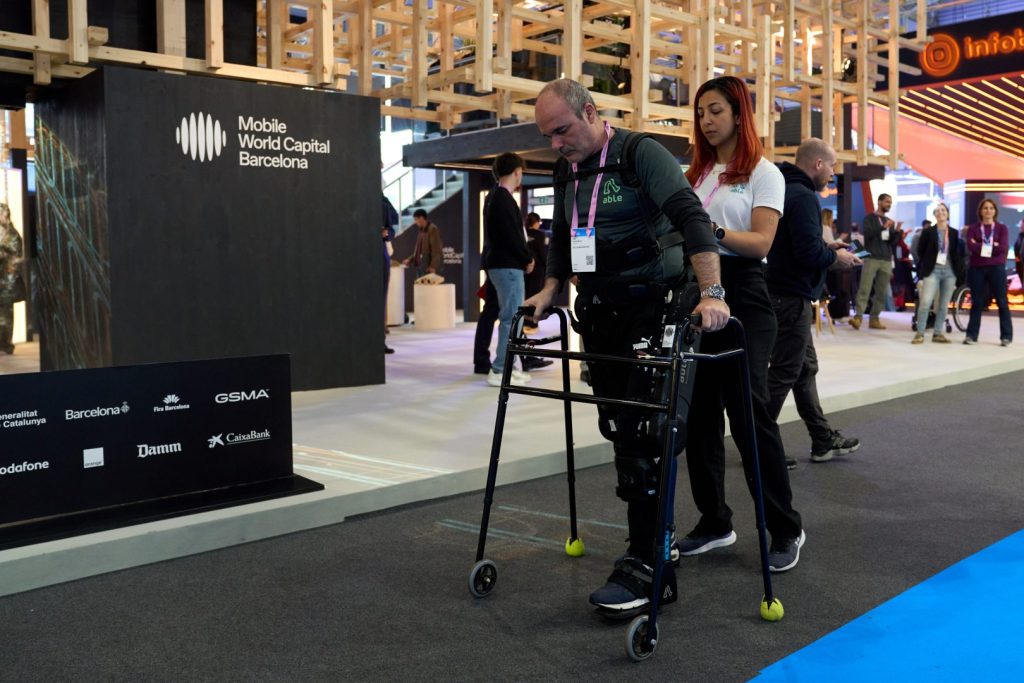
Mobile World Capital Barcelona and Hospital del Mar are enabling MWC visitors to activate a robotic exoskeleton and see how a patient’s movement is converted into indicators that guide rehabilitation.
The exoskeleton, developed by Barcelona-based company ABLE Human Motion, is already being used in neurological rehabilitation sessions for patients with ALS and rare neurological diseases.
The exoskeleton generates progress reports to compare sessions and plan treatment based on objective evidence.
04/March/2026
Mobile World Capital Barcelona, Hospital del Mar and the Department of Health are showcasing at MWC26 how the application of technology is transforming neurological rehabilitation. At the Foundation’s stand, visitors can discover an innovative bilateral exoskeleton incorporating a device for capturing and analysing biometric indicators that enable close monitoring of patients’ progress.
The exoskeleton has been manufactured by Barcelona-based company ABLE Human Motion, a spin-off founded in 2018 by industrial engineering students from the Polytechnic University of Catalonia. At the end of 2025, it was acquired by the Department of Health as part of a European-funded programme to promote innovation in the treatment of rare diseases and ALS, and subsequently provided to Hospital del Mar for use in neurological rehabilitation sessions.
The exoskeleton provides therapists with valuable information when working on patient rehabilitation, such as the number of steps taken, time spent standing and walking, and the symmetry between the right and left step. All this information is displayed instantly on a screen integrated into the back of the device. This allows therapists to tailor each session to the patient’s real needs and analyse progress based on objective data.
At the end of each session, the exoskeleton generates a summary showing the averages for each indicator. Therapists can also request a progress report at any time, selecting multiple sessions to assess the patient’s development. One of the key advances offered by this innovation is gait analysis, which enables comparison of essential walking parameters across sessions, such as the support time of each foot or step speed. This facilitates objective clinical monitoring and precise treatment planning.
These features are particularly useful in asymmetric injuries, such as those caused by stroke. If the data shows, for example, that the right step is significantly shorter than the left, the professional can increase assistance from the right motor to restore a more natural gait pattern. Over time, assistance is gradually reduced to assess whether the patient can integrate the movement independently.
Greater safety and new therapeutic opportunities
Exoskeletons enable repetitive, physiological and safe training, which is key to stimulating neural plasticity and recovering impaired motor functions. According to Dr Anna Guillén, Head of the Neurological Rehabilitation Section at the Physical Medicine and Rehabilitation Department of Hospital del Mar, these devices “intensify and make walking safer, offering potential improvements for patients while physically relieving professionals and providing objective data to support therapeutic decision-making”.
Studies conducted in patients with multiple sclerosis or Guillain-Barré syndrome have shown improvements in endurance, walking speed and balance through the use of exoskeletons. Increased confidence when standing and a reduced risk of falls have also been observed, opening up the possibility of working with more severely affected patients. In addition, the ability to walk longer distances with less perceived effort boosts motivation, a critical factor in rehabilitation.
For medical staff, the exoskeleton offers new therapeutic opportunities. Reduced physical strain eliminates the need to manually support patients while walking, improving ergonomics and lowering the risk of injury among physiotherapists. It also allows professionals to focus on clinical analysis and therapeutic adjustments rather than purely physical support tasks.
At the same time, the ability to continuously record patient data provides a level of objectivity in treatment that was previously difficult to achieve.

Image presenting the experience (from left to right): Eduard Martín, CIO of MWCapital; Ariadna Tigrí-Santilla, Director of the Physical Medicine and Rehabilitation Service at Hospital del Mar; Alfons Carnicero, CEO of Able Human Motion; Esther Marco, Director of the Physical Medicine and Rehabilitation Service at Hospital del Mar.
Technology at the service of health
The experience at the MWCapital stand allows visitors to assume the role of therapist, activate the exoskeleton and observe in real time how patient movement is transformed into biometric data.
The experience is complemented by an audiovisual piece showing how this technology is currently used in rehabilitation sessions for patients with conditions such as ALS, Guillain-Barré syndrome and hereditary spastic paraparesis at the Hospital del Mar rehabilitation unit.
A preliminary, non-certified version of the device was presented at MWC two years ago. Now, the MWCapital stand features an innovation that is already part of the regular therapeutic circuit for several patients at Hospital del Mar. Through this experience, the Foundation demonstrates how robotics and data-driven treatment are redefining rehabilitation and opening a new chapter in the care of patients with conditions such as ALS, multiple sclerosis and Guillain-Barré syndrome.
The use of exoskeletons as a rehabilitation tool is already a reality in several public hospitals in Catalonia, including Vall d’Hebron, Parc Taulí, Germans Trias i Pujol, Bellvitge, Sant Pau and Hospital del Mar, reflecting the strong technological momentum within Barcelona’s healthcare sector.
Stay up to date about everything
Subscribe to stay up to date with the latest content from Mobile World Capital Barcelona.