
During his speech at Talent Arena, the inventor of the World Wide Web analysed how artificial intelligence is driving the next evolution of the Web and advocated for a more open, decentralised and user-focused Internet
- Berners-Lee also stressed that “AI should be developed in an open and collaborative way to ensure that people are not harmed.”
With the presence of leading technology figures such as Berners-Lee, Talent Arena strengthens its position as a leading European platform for debating the future of the Internet and emerging technologies
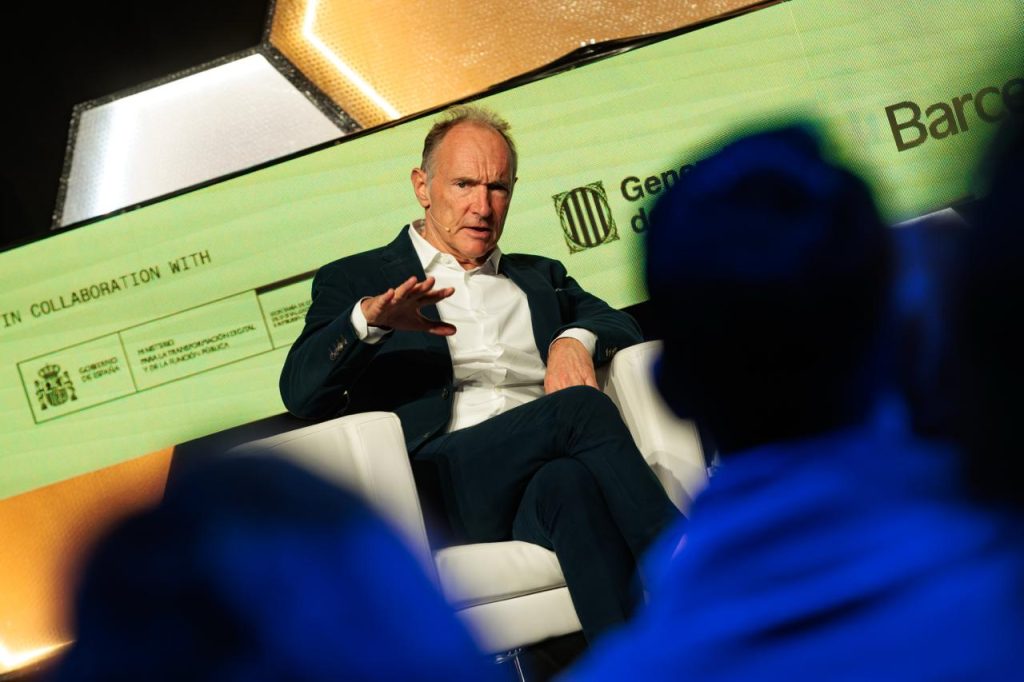
The second day of Talent Arena, an event organised by Mobile World Capital Barcelona, featured the participation of Tim Berners-Lee, inventor of the World Wide Web, as one of the most anticipated sessions of the programme due to his iconic role in the history of the Internet. During his keynote, Berners-Lee reflected on the current state of the Web and its prospects, in a context marked by the expansion of artificial intelligence and emerging technologies.
The expert analysed the key turning points that have defined the evolution of the Web and highlighted how new technologies are transforming the way people interact with information and manage their data. Berners-Lee underlined that, while AI and other innovations offer opportunities to improve efficiency and personalisation, they also pose structural and ethical challenges that must be addressed to ensure an open, user-centred Web.
In this regard, he referred to social networks and stressed that they should be designed without generating addiction: “The web is everything, but an important part of it is social networks; these have learned to train AI within their systems to optimise the time people spend on the platform, with engaging content and a clear intention of generating addiction in society.”
Berners-Lee argued that “AI should be developed in an open and collaborative way to ensure that people’s rights are not harmed.”
Awareness of personal data
Another key topic of his keynote was Solid project, an initiative created by Berners-Lee himself that proposes a decentralised Web and returns control of personal data to users. Solid enables individuals to decide who can access their digital information, offering a more secure and autonomous privacy model in response to the concentration of data within large corporations.
“Applications constantly store personal data; we all have personal clouds and simply accept it, which is quite disempowering. With Solid, the protocol involves storing data in a way that asks you where you want to keep it; you control your own data,” he explained.
Berners-Lee shared examples of how this initiative is already operating and acknowledged that its global adoption still faces technological and cultural obstacles that require coordinated strategies at an international level.
The participation of an iconic technology figure such as Tim Berners-Lee reaffirms Talent Arena as a leading European platform for reflection about the future of the Internet and the impact of emerging technologies. The event, co-located with MWC Barcelona and 4YFN, brings together international leaders, technology companies and digital professionals to debate the major challenges facing the sector.
Stay up to date about everything
Subscribe to stay up to date with the latest content from Mobile World Capital Barcelona.