
The Foundation and the technology centre are presenting at MWC the experience The Bio-Circular Harvest, which demonstrates how hyperspectral scanning systems enable crop diagnostics to support farmers’ decision-making.
Visitors to the MWCapital stand can scan a real olive tree and assess the ripeness of its fruit, the plant’s water stress levels and the degree of infestation, helping to promote more sustainable and efficient production.
04/March/26
MWCapital and Leitat are presenting at MWC26 The Bio-Circular Harvest, an experience that demonstrates how technology is revolutionising the agri-food sector. The installation features a hyperspectral scanning system capable of analysing with great precision the different components of an olive tree planted at the Foundation’s stand. Visitors can carry out a digital scan of the tree and visualise, in real time, key data for crop optimisation.
The experience provides information on the fruit’s degree of ripeness, the plant’s water status and the level of infestation affecting the olive tree. This data enables farmers to determine the optimal harvesting time and to act in advance should anomalies or potential diseases affecting the fruit be detected. Through analysis of the crop’s physiological condition, an advanced reading is obtained, supporting evidence-based decision-making aimed at improving yields, reducing environmental impact and opening up new avenues for value creation by identifying potential new products derived from the fruit or the plant.
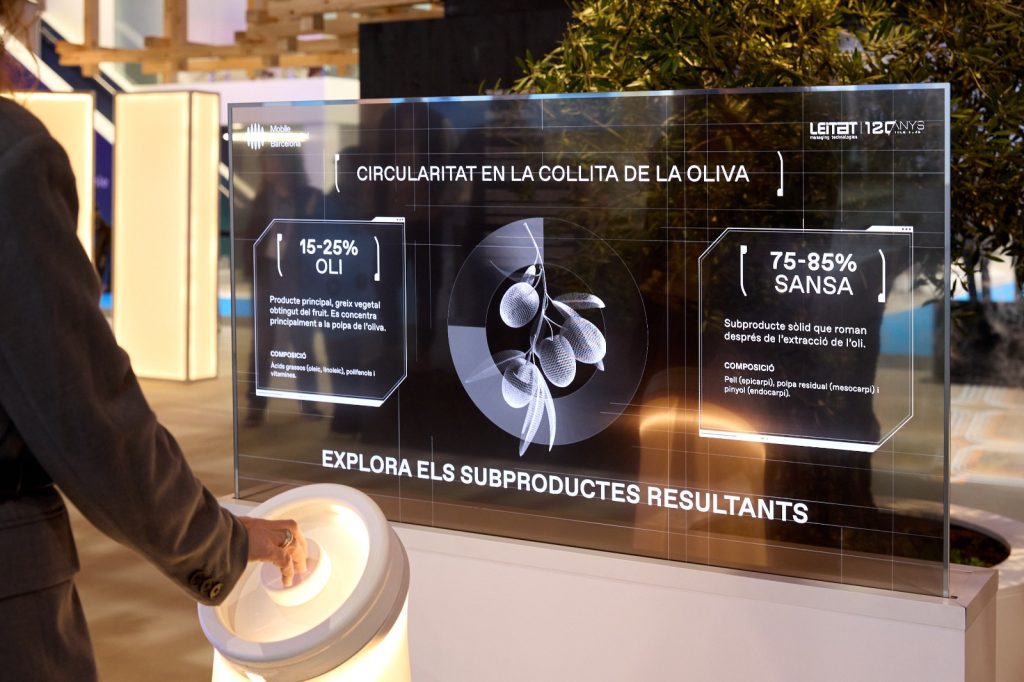
Beyond diagnosing the olive tree, the experience also presents data on alternative products that could be developed, such as cosmetic products, food ingredients, biofuels, fertilisers or value-added ingredients for other industries.
The installation illustrates how, depending on the three indicators obtained through hyperspectral scanning, olive production may change (generating more or less pomace, olives or oil), and how this directly impacts the resulting products. In this way, it highlights a more efficient, sustainable agri-food model based on the circular economy.
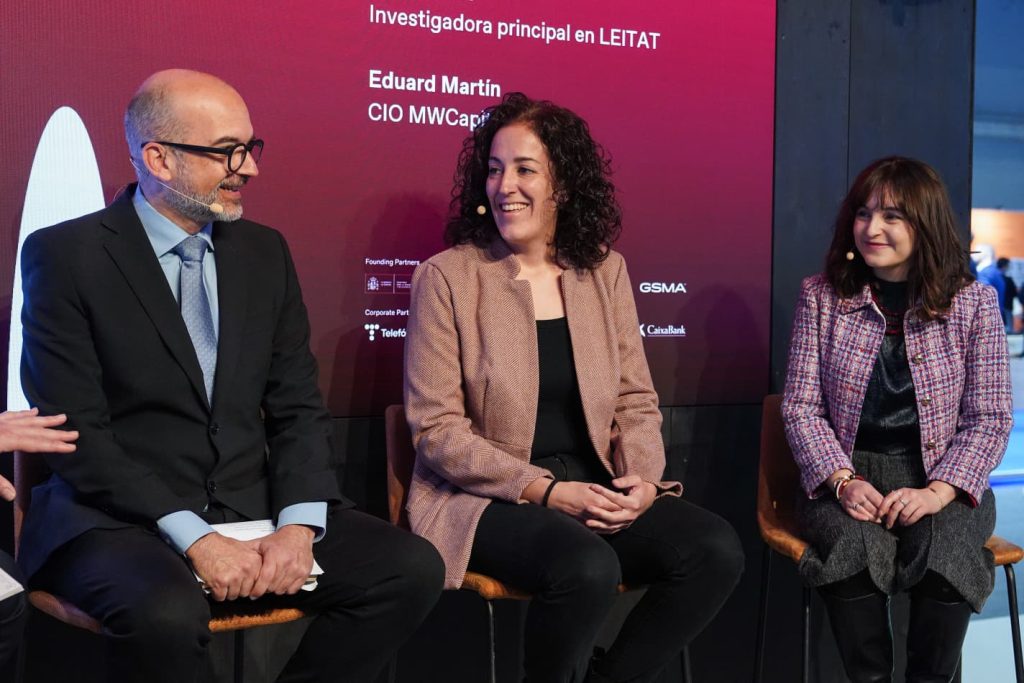
From left to right, Sergi Artigas, Director of Innovation Strategy and Technology Transfer at Leitat; Elena Torralba, principal investigator of the photonics and vision area of Leitat, and Irina Chirac, principal investigator of the Bioresources and Food Area of Leitat.
Hyperspectral scanning, a technology for more sustainable productions
The application of hyperspectral scanning enables farmers to monitor crops to maintain moderate water stress levels without affecting oil production. Studies indicate that this can reduce water consumption by up to 35%. In addition, controlling the timing of the harvest helps optimise oil extraction and preserve fruit quality. Research shows that harvesting olives at their optimal stage for oil production can increase yield by up to 20%.
Applied to the agri-food sector, this technology provides farmers with valuable information to obtain a precise diagnosis of the physiological condition of fruits and plantations, enabling decisions that improve productivity, reduce environmental impact and create new opportunities for value generation.
The integration of technology into the agri-food sector supports more sustainable production processes and helps address one of today’s major challenges: feeding a constantly growing population. The United Nations estimates that the global population will increase from the current 8 billion to 10.3 billion over the next 50 years.
From an environmental perspective, technologies such as those showcased at the MWCapital stand – including AI and machine learning – make it possible to analyse soil, climate and crop imagery data to detect outbreaks at an early stage, reducing the use of chemicals and optimising productivity.
Furthermore, hyperspectral scanning provides strategic insights to promote the valorisation of products and reduce food waste. Through the application of valorisation technologies based on the biorefinery concept, it is possible to obtain new ingredients and value-added products for relevant industrial sectors. This approach supports progress towards a sustainable, zero-waste agri-food model.
Stay up to date about everything
Subscribe to stay up to date with the latest content from Mobile World Capital Barcelona.